
Singapore’s Electric Motorcycle Market Stalls at Home as Local Firms Find Growth Overseas
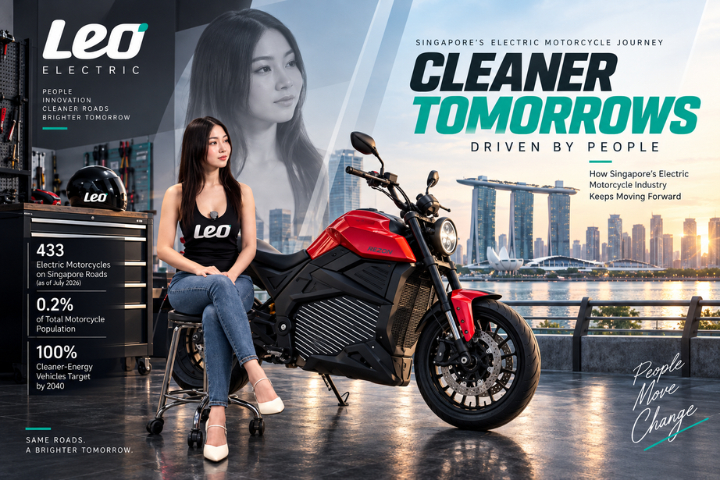
Singapore’s electric motorcycle industry is exploring new paths to growth, from overseas expansion and existing EV charging networks to business fleets that could help drive wider adoption at home.
Singapore may be pushing towards 100 per cent cleaner-energy vehicles by 2040, but electric motorcycles remain a tiny part of the country’s two-wheeler population. As of July 2026, just 433 electric motorcycles were on Singapore roads, representing only 0.2 per cent of the motorcycle population, even as electric cars have grown to more than 69,000 units and over 10 per cent of the car population. Challenges including higher purchase prices, limited battery capacity, range anxiety and questions around charging have made electric motorcycles difficult to sell to everyday riders. Yet Singapore-based companies are not giving up. Several are finding much stronger opportunities overseas, while others are preparing a renewed push at home using existing EV charging infrastructure and business fleets as a possible route towards wider adoption.
_mbELMlc.png)
Singapore’s electric motorcycle industry is exploring new paths to growth, from overseas expansion and existing EV charging networks to business fleets that could help drive wider adoption at home.
Singapore Electric Motorcycle Firms Find Bigger Opportunities Overseas
For companies such as Kilats and Charged Asia, regional markets offer a scale Singapore simply cannot match. Kilats has operated in Indonesia since 2024 and rents almost 700 electric motorcycles to Grab in Bali and Bandung, supported by 44 battery-swapping stations. It plans further Indonesian expansion before entering Thailand by the end of 2026 and Vietnam and the Philippines in 2027, while keeping Singapore as its funding and regional business base. Charged Asia, meanwhile, currently generates all its revenue from Indonesia, where it has deployed more than 5,000 motorcycles, and says it is on track to deploy more than 300,000 units regionally over the next few years, with Malaysia also targeted for expansion. Leo Electric has similarly explored opportunities in Nigeria and the Middle East, although infrastructure and geopolitical challenges slowed those plans. The attraction of Indonesia is particularly clear: its motorcycle population is estimated at between 112 million and 139 million, with motorcycles accounting for around 85 per cent of motorised vehicles.
Plug-In Charging Could Offer a New Route for Electric Motorcycles in Singapore
Some companies are now returning their attention to Singapore with a different strategy. Rather than relying entirely on dedicated battery-swapping networks, Leo Electric and Kilats are working to introduce an electric motorcycle that can plug into charging infrastructure already used by electric cars, while Charged Asia also plans to launch a similarly chargeable model locally. Leo Electric says its motorcycle will cost slightly more upfront than a comparable petrol model but could deliver savings over time through lower fuel and maintenance costs. The debate over charging versus swapping remains unresolved, however. Kilats argues Singapore’s high-speed road and expressway use requires larger-capacity batteries that are less suited to manual swapping, while Gogoro and Cycle & Carriage remain committed to battery swapping. Gogoro currently has seven swap stations across Singapore, and Cycle & Carriage sold 46 Gogoro electric motorcycles in 2025. The company argues that swapping can replenish a motorcycle in under 60 seconds, compared with at least 30 to 60 minutes for a full charge. Importantly, LTA has also confirmed that electric motorcycles are permitted to use EV charging points across Singapore.
_aSSmiP2.png)
Singapore’s electric motorcycle industry is exploring new paths to growth, from overseas expansion and existing EV charging networks to business fleets that could help drive wider adoption at home.
Businesses Could Drive Adoption Before Everyday Riders Are Ready
The more immediate opportunity may not be individual riders at all. Industry players believe business-to-business fleets could provide the scale needed to establish electric motorcycles before the technology becomes attractive to the mass market. Government-related organisations, logistics operators, last-mile delivery services and quick-commerce companies could benefit immediately from reduced petrol expenditure while also facing increasing pressure to meet sustainability targets. Greater fleet adoption would put more electric motorcycles visibly onto Singapore roads, potentially building consumer confidence in their reliability and operating costs. Industry representatives have also called for stronger government incentives, pointing out that schemes supporting the electrification of cars and commercial vehicles do not currently provide equivalent support for motorcycles. Suggestions include emissions-based penalties for more polluting motorcycles, subsidies for electric alternatives and targeted grants or tax incentives encouraging delivery, leasing and logistics fleets to make the switch. Affordability nevertheless remains a major obstacle because motorcycles with useful range and battery capacity command a premium, while many motorcycle buyers have tighter budgets than car buyers.
Electric Motorcycles Still Face a Long Road Before Going Mainstream in Singapore
Singapore has already taken steps to support electric motorcycles, including creating regulatory pathways for homologation and deployment, expanding charging infrastructure and working with industry on battery swap-and-charge stations. But fundamental technical challenges remain. LTA points to the shorter range and lower power of electric motorcycles compared with petrol equivalents, while transport experts note that motorcycles cannot simply carry increasingly large batteries in the way cars can—additional capacity quickly adds both weight and cost. The collapse of Mo Batteries’ planned swapping service, after the company cited the time and investment required to meet regulatory requirements, also illustrates how difficult building a new ecosystem can be, although Gogoro continues pursuing the concept. For now, Singapore’s electric motorcycle companies appear to be taking a two-track approach: grow in motorcycle-heavy overseas markets while using fleets, existing EV chargers and improving battery technology to gradually build a viable market at home. If costs fall and technology continues improving, the current 433 electric motorcycles could eventually represent the beginning rather than the limit of Singapore’s two-wheeled electric transition.