
Evoke a feeling of nostalgia as we guide you through the his
Bimota is an Italian motorcycle manufacturer founded in 1973. The company took part in racing competitions to decent success throughout the years.

Firstly, the company was named after the surnames of its three founders: Bianchi, Morri, and Tamburini. When the company first started out, they helped to produce motorcycles for other motorcycle manufacturers, such as Kawasaki and Honda, using the engine as a basis. In 1972, Tamburini broke three ribs in an unfortunate crash. In the meantime, while convalescing, he built a strong and sturdy steel frame-set for Japanese manufacturers such as Honda and Yamaha. Following which, the Bimota Honda HB1, designed to be a race bike, was launched. During the 70’s, notable bikes designed for racing purposes such as the SB1, YB1, YB2, YB3, HDB1 and HDB2 were released and racers’ interest was piqued.
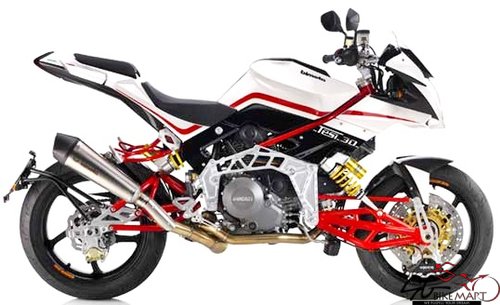
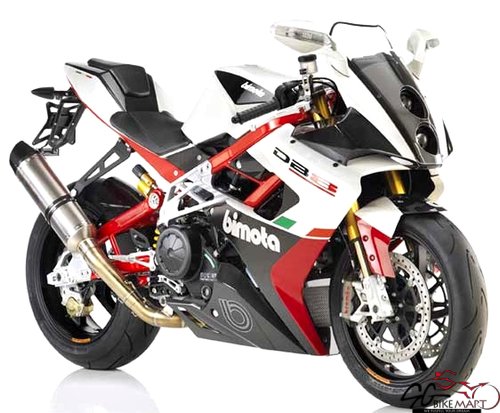
In 1977, the SB2 debuted and it was powered by a GS750 motor from Suzuki. During that same year, Bimota started to produce superbikes, such as the KB1. Following the release of the KB1, more people began to know about Bimota and it is touted to be one of the company’s most well-known and successful bikes.
The factory, located in Rimini, Italy, was doing very well in the 1980s. After Tamburini left Bimota in 1983, engineer Frederico Martini took over. Leveraging on his work experience in Ducati, he brought Bimota to greater heights and improved sales tremendously. Many models were manufactured in the 80’s, such as the KB2, KB3, HB2, HB3 and the Tuatara.
See the History of Bimota Motorcycles:
A decade later, Pierluigi Marconi took Martini’s position when the latter left the company. Bimota focussed on the Tesi project, which was unsuccessful. Many other models were also produced during this time, namely the SB6, YB8, Supermono, etc. In 1993, after co-founder Morri left the company, Walter Martini took over his place. Production on the bikes increased twofold under his leadership. In 2000, the 996cc V-Twin SB8R was produced using a Suzuki engine and was very well-received.
However, the 500Vdue project’s performance was subpar. Due to a defect in the engine’s design, it had to be redesigned. This led to the recall of the bikes. This, along with the aforementioned Tesi, left Bimota financially crippled and eventually led to bankruptcy.
In 2003, Bimota was revived by Roberto Comini and Sergio Robbiano. From then on, the company rose and was eventually re-established. The DB5, a model released by Bimota, even clinched the Motorcycle Design Award in the Intermot motorcycle show.
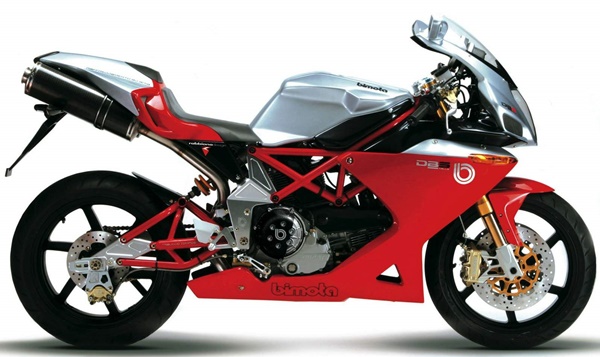
Image: motorcyclespecs
Bimota was no slouch in racing competitions either. In 1980, South African motorcycle road racer Jon Ekerold clinched the 350cc world championship. In 1988, former Italian superbike racer Davide Tardozi was victorious in five races in the World Superbike championship.
12 years later, in 2000, Australian Anthony Gobert won the Australia Grand Prix in Philip Island. The racing team was led by Italian Virginio Ferrari, who triumphed in the TT F1 World Championship on a YB4 I.E. in 1987.
News of closed down of factory of Bimota factory
Bimota Motorcycle List:
Images(Bimota Website)